



Proof Over Probability
Most security tools optimize for signal volume — more alerts, more noise, more triage overhead for your team. Strike7 operates on a fundamentally different model. Autonomous agents explore targets with creative, adversarial reasoning. But a finding is only surfaced when its exploitability has been independently confirmed through deterministic, non-destructive validation. This means zero false positives reach your remediation queue — only proven, reproducible exploits.
AI discovers. Deterministic logic verifies. Only proven exploits ship.
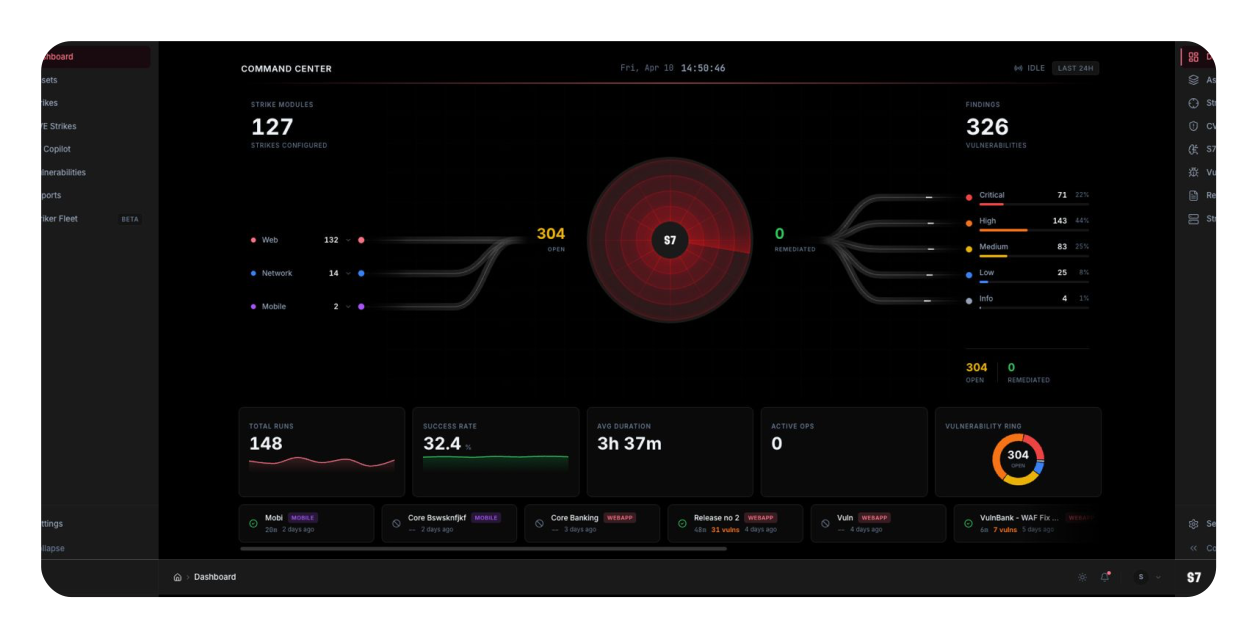
How Strike7 Tests Like an Adversary
Strike7 does not follow a static checklist. A persistent coordinator orchestrates thousands of short-lived, parallel agents — each initialized with fresh context and a narrowly scoped objective — to execute adaptive, multi-path assessments.

Define Scope & Launch
Initiate an assessment via the dashboard or API. Specify target domains, asset boundaries, authentication credentials, and any contextual guidance. Tests begin executing within minutes.

Map the Attack Surface
Agents autonomously crawl, enumerate, and fingerprint the target environment — identifying entry points, exposed services, API endpoints, and potential attack paths across the full perimeter.

Execute Adaptive, Parallel Attacks
Thousands of independent agents execute real attacks simultaneously. Each agent adapts in real time based on application responses, chains discovered weaknesses, and leverages proven offensive tooling (headless browsers, MITM proxies, exploit frameworks).

Validate & Enforce Safety
Every potential finding is independently verified through controlled, non-destructive exploit validation. If a vulnerability cannot be confirmed with a reproducible proof-of-exploit, it is not reported. AI explores — deterministic logic decides.
Architecture Built for Scale & Trust
Strike7's architecture coordinates autonomous AI agents, deterministic exploit validators, and production-grade offensive tooling within a controlled execution environment — engineered for complex, large-scale production deployments.
Coordinator & Analysis
Persistent coordinator builds the plan of work, tracks understanding of the target, and prompts the LLM for queries and reasoning.
AI Agents
Short-lived, parallel agents handle session management, discovery, and attacks against the target.
Proxy
Man-in-the-middle proxy injects payloads and captures exploits as they fire.
Attack & Validation Tools
Headless browsers simulate users; validators check evidence — all running through instrumented exploration.
Validation
Deterministic proof and out-of-band callbacks confirm exploitability before anything ships.
1 — Coordinator & Analysis
Queries & Reasoning
2 — AI Agents Creative Explanation
Session Management
Agents
Discovery
Agents
Attack
Agents
3 — Proxy
MITM
Payloads
Exploits
4 — Attack + Validation Tools
Headless
Simulated User
Validators
Check Evidence
5 — Validation
Proof
Deterministic
Callback
Out-of-band calls
Why Multi-Agent Architecture Outperforms Monolithic AI
Single-agent AI systems and traditional scanners struggle at scale. Long-running agents accumulate incorrect assumptions, lose context, and get stuck. Checklist-based tools prioritize volume over certainty.
AI Explores
Logic Verifies
Authorization bypass on createUserActivity
STRIKE7-2026-0411 · severity high
$ mutation { createUserActivity(
  userId: "victim-7821"
) { id, timestamp } }
→ 200 OK · INSERT reached
Findings
23
False pos.
0
Time
4h 12m
Built for Production Environments
Non-Destructive Validation
All exploit validation is executed through controlled, non-destructive techniques. Strike7 confirms exploitability without modifying data, corrupting state, or disrupting live systems. Validation logic is deterministic, consistent, and fully auditable.
Observable and Constrained
Every agent action is logged, scoped to defined boundaries, and subject to operational constraints. Full audit trails are available for every assessment, providing the transparency compliance and security teams require.
Compliant Deployment
Deployment options are architected to meet enterprise security, data residency, and regulatory requirements including ISO 27001, SOC 2, PCI DSS, GDPR, and HIPAA.
See Autonomous
Offensive Security
in Action
Strike7 surfaces real, exploitable risk — continuously and at scale. AI agents discover. Deterministic logic validates. Your team remediates what actually matters.